
Nostalgia(how ‘Ghatak’ made to my watch-list)
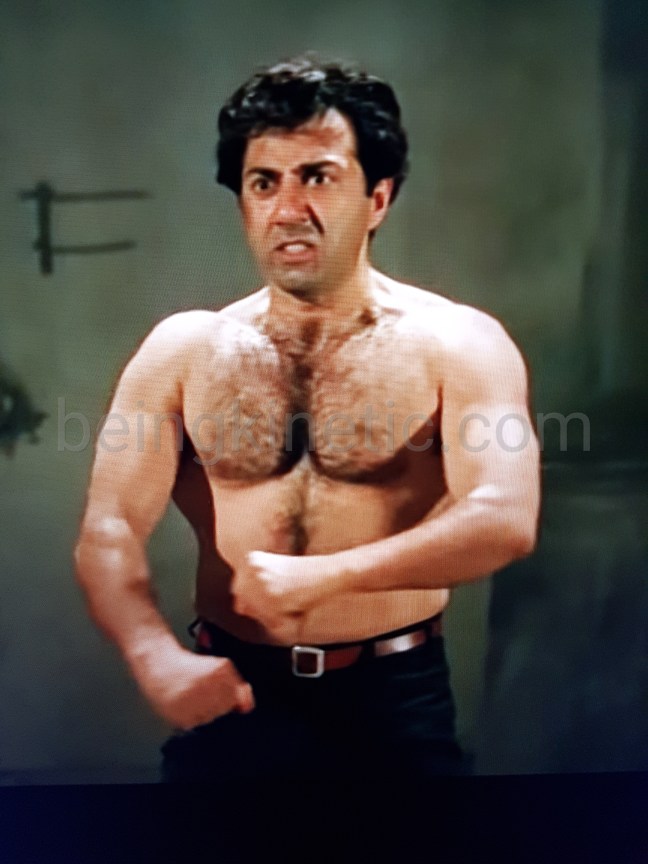
“These sucklings have gone nuts after watching that latest movie starring Sunny(Deol). He tears off his own vest during a wrestling match, shows off his chest and biceps – now these kids(who have just learnt to put on pants by themselves) want to build a physique like him and wrestle! What can I do?“
Quoted in 1996, by my/the gym instructor.
It was 1996(I don’t recall the month but it was barely a couple of days after ‘Ghatak‘ was released, actually, the movie is the reason why I could deduce the year, when the narrated incident happened.). My father himself was a movie buff and he regularly took me to the cinemas in my hometown.
I was 11 year old and short(height), for my age, and like most of the kids of that generation, I looked even younger. My father(a short but a well-built, old-school gym and gymnastics man) was upset with my fragile built, poor stamina and short height. One day, he lost his patience and dragged(back in the days, kids didn’t have the luxury to question or resist the orders issued by the parents, especially, fathers!) me to a nearby public/municipal gym. Note that this was not a fancy gym like we see in today’s globalized world but a vintage ‘ व्यायामशाळा ‘. He expressed his frustration to the gym instructor(who himself was a short but muscular guy) and asked him to ‘drill, train and shape’ me. Dad left immediately, leaving me to the mercy of the instructor.
The instructor took me to the section where many young men, college boys and adults were training hard. Being the only kid(well, in those days, it was rare for a school kid to train in gym. We were mostly found outdoors.), I was greeted by a rollicking laughter by everyone(around 20-25 men), as they gathered around. Looking at my countenance and physique, the men questioned the gym instructor’s rationale behind admitting a feeble creature like me, that is when the former quoted the leading lines.
Further lines uttered by the men present there and following events have not been reproduced.
When I returned home, the instructor’s remark ringed through my ears. I persuaded my father to take me to the cinema, and within the next couple of days, I ended up watching ‘Ghatak’.
Since the early 2000s, I have watched this movie at least a dozen times, in various walks of life. After procrastinating it for a decade, the writer has finally penned his thoughts.
P.S: How my gym journey progressed(?) is something unworthy of any further discussion, the readers are requested to forget that I even mentioned it 😛 .
Preface
IMHO, Sunny Deol is(was?) the last action hero of Bollywood. I will (hopefully!) write posts dedicated to the last ‘angry young man’ and his various roles, but for now, I will focus on the movie which had a profound impact on my life – ‘Ghatak‘(Hindi: घातक).
This post is for the readers who have watched the movie. I have not reproduced the plot or synopsis.
I have tried to add YouTube video links, wherever possible, but the fate of YT videos is uncertain. I would be glad if the readers report the broken links via comments or email.
Mise-en-scène
Before the readers (try to)proceed with the reading, I present the (IMHO)best scene from the movie. I am sure it will pump up the viewers!
Themes
Commentary about social issues
- Fate of the lonesome leaders:
Sachdev is a representative of the selfless, daring but unfortunate leaders of the Indian society. He takes the lead when the others are quivering(note he does what is required in the Indian democracy – holding the elected representatives accountable), lawfully tries to defend and advocate everybody’s rights. As the History and present have manifested the fate of such lonesome leaders, Sachdev loses his life. Think about the fate of the revolutionary patriots during the Indian struggle for Independence 😦
- Failure to nip the evil in the bud:
Watch the scene where Sachdev criticizes his co-residents about their pacifist attitude towards the goons e.g: When Damu kaka advises avoiding any conflicts with Katiya, Sachdev blasts everyone by reminding them their mistake of agreeing to pay extortion money to Katiya‘s brother, the first time the demand was made – a petty amount which gradually increased and finally, Katiya dared to evict the shopkeepers. Sachdev rightly pinpoints the exact issue – had the residents thwarted the first, nascent attempt to extort money, Katiya would not have turned into such a big threat.
- The good cannot reason with the evil:
– When Shambhu Nath boasts his glorious past of participating in a Satyagraha, Shiv rubbishes the validity of Shambhu Nath‘s principles – he gives example of Sachdev who was slaughtered at the crossroads, in broad daylight.
– When Kashi is being beaten up by Katiya‘s henchmen and brothers, a life-long idealist, patriot and a Satyagrahi like Shambhu Nath crumbles and collapses, and gives in to Katiya‘s terror. The following heart-wrenching scene where Katiya humiliates Shambhu Nath, raises the age-old question – the sensibility of practising Ahimsa when dealing with sheer evil elements!
– Shiv‘s desolation highlights the plight of the common man in India – just watch this scene where he says ‘जिसकी लाठी उसकी भैंस‘.
- Strength respects only strength:
Kashi‘s war against Katiya and the climax scene where the residents take law in their own hands(God forbid!Such situations should not arise, at least in a democracy!!!) highlight the importance of strength and defiance – evil has to be taken down by force! This is a stark truth of human life and sadly, the Indian masses have, and are being, brainwashed to believe otherwise. - Survival of the one who fights for survival:
IMHO, this is the most profound theme highlighted throughout the movie. One has to stand for self-esteem and rights, if the system fails to do so.
– Munna is afraid of the black cat that sits in the window, Kashi encourages Munna to drive it away – Kashi suggests that one should not get scared of an intruder, instead, should throw him out!
– Shiv bashes the residents when the latter suggest hiring wrestlers like Kashi to counter Katiya.
– The scene best describing the survival aspect is the one where Kashi warns the police inspector to avoid helping the residents(there are politicians in India which have openly announced that they will kill hundreds of people, if the police is removed for few minutes!) of Gol Chowk – he declares that only the ones who will fight for their rights, use their own will and strength, have the right to live.
- Cowardice of the masses:
Nothing new here – a timeless fact, hence, (conveniently)ignored. Almost in every significant scene, this fact is highlighted, I have mentioned only a few:
– The residents are barely able to speak up during their visit to Katiya‘s house, who terrorizes them by asking one of his henchmen to chop-off his (henchman’s) own finger.
– Malti is dragged by her hair and beaten by Katiya‘s goons, again, residents are mute spectators.
– Kashi is chained, beaten and dragged out of the house but the neighbors and other residents are mere spectators, same happens during Shambhu Nath‘s funeral. There have been countless crimes in India where the spectators did nothing to help the victims.
– The most sombre but motivating/inspiring scene of the movie is where Shambhu Nath explains to Kashi about the root cause of the problem(fear of masses and the dire need to embolden them):
Masculinity
- Let us first consider the villains – Katiya and his brothers. They are depicted as sadistic, toxic and ultra-masculine. The police inspector explains Katiya‘s nature – uninterested in womanizing, dancing, TV, etc. Even when Kashi wins the fight, Katiya invites him to his gang saying “यहाँ मर्दों के बीच रहो”(Be in the company of macho men).
Katiya likes to tame wild animals, treats them and humans as his tamed pets – he even insults Shambhu Nath by treating him like a dog. - Our hero, Kashi, is a hardworking, common man but free from any habits that would harm his body, well-built and a trained wrestler. The opening scene of the movie itself is quite empowering – Kashi comes out after a swim in the waters of Ganga and walks towards a Mahadev temple for offering prayers.
- The father-son bond isn’t high on the list of depictions of social life in Indian movies but ‘Ghatak’ does a commendable job here.
- Kashi challenges Katiya‘s ideas of toxic masculinity and oppression and vehemently defends ideals of being a hard-working, honest but a strong man.
Note the WWF influence(my cousin and I ended up hitting each other while trying to emulate a fight, till date, the incident has not been reported – brother code, after all) is clearly visible e.g: Akram Khan Bakthoni(my guess, Ponnambalam) was clearly inspired by Papa Shango.
- Kashi fearlessly waits for a feared goon. For a common man, this fearlessness and confidence is a much-desired, feature.
Idealism
- Heroes of Indian Independence Struggle a.k.a freedom fighters. Shambhu Nath belongs to the old breed which wanted to elevate India to progressive and strong republic and his following actions represent the dreams of those glorious men and women who fought for gaining independence:
- He reprimands the Varanasi residents for not keeping their respective areas clean. He criticizes the hypocritical behaviour of the citizens – wearing clean clothes but not maintaining civic cleanliness. Like a typical freedom fighter, he volunteers to do things himself – here, cleaning the streets.
- Despite of a failing health, he is eager to get back to the pending social work activities.
- Kashi is proud of his strength and meager earnings from honest, hard work. He out-rightly rejects Katiya‘s offer to be his gang member. His attitude is a lesson for every common man – to be happy with whatever is earned by honest work but also have self-respect and a strong physical and mental stature.
Decadence
- The rampant corruption and the shamelessness of not respecting the value of being citizen of a republic are impeccably shown in the scene where Shambhu Nath and Kashi are struggling to get a bed in a hospital.
- The low-quality lifestyle of masses in Mumbai, especially, lack of space and the commute drudgery.
- Gauri is a dancer in a night club and is looked down upon the policemen, and even Kashi. While that profession may not be desirable, those workers have a right of respect.
What endears Kashi and ‘Ghatak’ to the common man?
This is my take – opinions can differ! Remember, the movie was a box office hit.
A common man, at least in India, stoically and cowardly bears aplenty injustices meted to him. He mutely witnesses the nexuses of police, goons and politicians shaking the foundations of the society. Deep in his mind, he wishes, even fantasizes retribution, and cleansing the society.
Kashi is the voice of this common man and an embodiment of his suppressed desires to get justice. Kashi is proud of being a common man, yet is powerful enough to thwart the anti-social elements.
Cinephilia
With the themes and it’s impact discussed in the preceding sections, I would like to highlight the other aspects of the film.
Screenplay
The ‘Themes‘ section has detailed the strengths of the screenplay. The only aspect I wish to underline here is that ‘Ghatak’ is a common man’s story – his humble expectations from life and the system, his tolerance, his cowardice, his frustration with evils like corruption, anti-social elements and finally, his desire to act brave, uproot the evil and lead a fearless life. Of course, a common man doesn’t beat up goons(it’s the other way!) out in the public but that is not the point of debate. Remember, the themes mentioned in the movie are still relevant. Critics(?) may pan the screenplay in 2020 and upcoming years but it belongs to the era where villains weren’t glorified and there was a clear determination to show bad as bad, evil as evil.
Overall, the screenplay is sound and engrossing. Rajkumar Santoshi won the (1997) Filmfare Award for Best Screenplay for ‘Ghatak’.
Cast and Acting
Apart from Kashi and Katiya(Danny Denzongpa), the most significant character is Shambhu Nath, played excellently by Amrish Puri. Even though I can imagine the outburst of a righteous, law-abiding common man, Sachdev‘s portrayal by Om Puri appears a bit hyper and loud. K. K. Raina made his presence felt in the role of a commoner(Shiv, Kashi’s brother). The other characters like Malti, Gauri, the residents of Gol Chowk, fit properly in the premise. Tinnu Anand and Viju Khote are known more for their comic performances, thereby, they appear a bit as misfits in their respective characters. Most of the actors appearing in this film can be seen in Santoshi’s ‘China Gate‘ as well.
Scenes
In the preceding sections, I have provided links to some iconic scenes from the movie. There are others which may not be intense but demonstrate the apt direction.
Quotes
Like most of Sunny Deol’s action movies, the memorable quotes are contextual, but have a profound impact on the viewers. In the below list, I have skipped all, except one, high-octane quotes found in the ‘best scene‘ of the movie:
- क्या इज्जत से जीना पाप है? हम सिर उठाकर जीना चाहते हैं।
- क्रोध को पालना सीख।
- बुजदिल की कहीं कोई जमीन नहीं होती।
- हक की लड़ाई गुंडागर्दी नहीं होती।
- किस हक की बात कर रहा है तू? चाट गई उस शब्द को दिमक इन किताबों में। यहां सिर्फ एक कानून चलता है – जिसकी लाठी उसकी भैंस।
- जमीन आपकी इज्जत है, और इज्जत से बढ़कर कुछ नहीं होता।
- … घर में घुसकर मारूंगा – सातों को साथ मारूंगा -एक साथ मारूंगा।
- सातों को एक साथ मारने की कसम क्या खायी – सातों भाई अलग-अलग घुमाने लगे!
Trivia
- I recall reading some articles in 2018/19 about a planned sequel to ‘Ghatak’. It was said that Santoshi and Deol have again teamed-up for the same.
- The work for Ghatak started in 1990, right after ‘Ghayal‘ but the movie was delayed for various reasons, finally released in 1990. Slight changes in Sunny Deol’s physique can be noticed in various scenes.
- The original choice for the lead actor was Kamal Haasan but the distributors persuaded(thank God!!!) Santoshi to cast Sunny Deol.
- As a child, I liked only a few actresses and Meenakshi Seshadri was one of them. She was set to retire earlier, but delayed it for ‘Ghatak’.
- Amrish Puri received his second filmfare award(1997), in the same category – best supporting actor. The first one was for ‘Meri Jung‘.
- The movie was a blockbuster/box office hit.
Music and Background Score
First, a line of appreciation for Vanraj Bhatia who has given apt background score for an intense movie like Ghatak.
While the soundtrack isn’t high on the priorities of such movies, ‘Ghatak’ has failed here, almost miserably. Except Anu Malik‘s ‘कोई जाये तो ले आये ‘, the other songs fail to make an impression. The legendary R.D. Burman composed gems for his last movie 1942: A Love Story but for reasons unknown, he couldn’t do justice to ‘Ghatak’. Ironically, a similar socially-oriented movie, ‘Gardish‘(1993) was blessed with some good compositions by R.D! The delayed filming could be the reason – R.D passed away in 1993. The director/producer is undoubtedly to be squarely blamed for, not only for the music but also asking the lyricists to write songs entirely irrelevant the movie’s plot and themes.
Costume and Makeup
Like mentioned earlier, the screenplay is focused on the common man, accordingly, the makeup and costumes are simple and non-invasive. For instance, observe Kashi‘s dresses – ordinary shirts and trousers, a hardly noticeable belt, commoner’s leather shoes. Including Katiya, did you notice any character wearing a dazing makeup? Utmost care is taken to avoid any glamorous touch to the makeup or costumes.
The overall feeling that a viewer gets is looking at people similar to the commoners we see in daily life.
Bollywood’s degeneration
While this section demands a separate series of posts, I will list a few aspects, highlighted by comparison of movies like ‘Ghatak’ and the post-2000 era:
- Contradicting claims by viewers and makers alike:
They say that realistic movies make a little sense – people don’t pay to watch realistic stuff but they like to watch their fantasies! Well, ask a common man his fantasies – isn’t viewing someone like Kashi a rightful fantasy? Isn’t uprooting the evil from the society every citizen’s wish? Citizens spend hours – daily and for years, cursing and discussing social evils and problems and wish for a better society and country! - I have already said this innumerable times – Bollywood hasn’t been blessed by an action hero after Sunny quit action movies. Merely having a ‘well-built’ physique and jumping and kicking people on the screen doesn’t make you an action hero! The intensity, the outburst, the body language, the voice and tempo – everything has to be exhibited.
- Lack of formidable villains: An exercise for the readers – count the formidable, memorable villains that Bollywood produced after ‘Jagira’ in ‘China Gate’.
- The preposterous glamour unleashed on the masses and enforced, especially on the male actors – 6-pack abs, wings and curves, upstart hairstyles, expensive clothes, cars, money and what not! Dharmendra, Sunny were Bollywood’s masculine representatives. Their physiques appear naturally built, similar to the vintage Indian men who used to eat healthy food, exercise or work hard. Take example of ‘Ghatak’ itself – do you see Sunny’s 6-pack abs or a similar glamorous features flaunted by today’s male actors?
- Decline of parallel cinema: Santoshi and few other directors, producers tried their best to sustain the trends started by the parallel cinema – the social awareness and depiction of problems faced by the country. Post-2003/4, even these attempts ceased.
- Instead of inspiring, diverting the focus of the masses. While I have absolutely no issues with romantic movies being produced, I reject the practice of bombarding all the age groups(from 8 to 80) with movies depicting, and encouraging, their love, affairs, broken relationships and so on. Even though the kids were lightly mocked, they wished to build a physique to wrestle, after watching Sunny’s movies. Today, Bollywood is teaching kids and boys to chase their future female mates – as if there is nothing else in life worth doing!
- The common man and his predicaments have almost vanished from the mainstream movies. He is now forced to watch unrealistic and cheap comedies, love/sex/affairs stories and so on – under the veil of ‘releasing stress by showing fantasies’ !!!
Epilogue
In spite of having written a mile-long post, there are aplenty thoughts and observations pertaining to the movie which I have scribbled in my private notes. I might update this post in future.
Every Indian should watch ‘Ghatak’ and retrospect. Maybe, the viewers will change their taste, which in turn might pressurize the film makers to create some realistic and inspiring content.
 Life is about being kinetic