
Overview
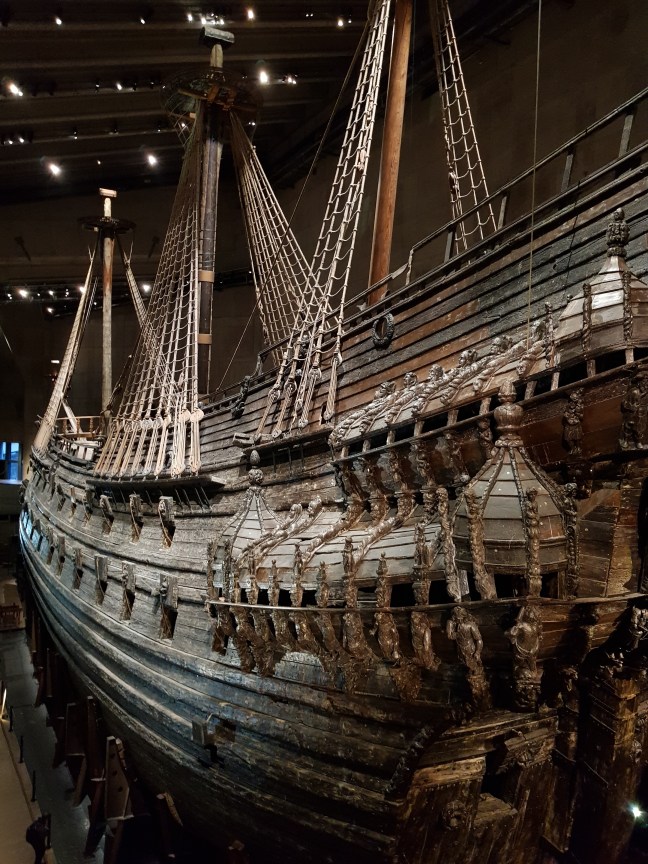
Vasa(named after the royal family name) was a warship commissioned on August 10, 1628 for the Swedish Navy. It sank on its maiden voyage, after sailing for barely 1.5km from the dock.
It lied submerged in the bay for 333 years, and 247 days, until it was salvaged on April 24, 1961.
Today, it is one of the top 5 well-preserved shipwrecks, and an excellent museum.
Context
As like the major European powers, Sweden also was trying hard to gain naval prowess. It was indispensable for protecting trade(happening mostly via ports), protecting territory, and also expanding it.
Baltic Sea was a major contention zone between powers like kingdoms of Sweden, Norway, Denmark, and Polish-Lithuanian empire. Gustav II Adolf(reigned 1611-1632) wanted to intimidate the opponents by showcasing naval strength, thereby, ships like Vasa were built.
Chronology
May 1618: 30 Years War commenced.
Mid-1625: Denmark enters the 30 Years War.
January 1625: Gustav II Adolf signed a contract of operation of the naval yard in Stockholm with two Dutch businessmen – Henrik Hybertsson, and Arendt de Groote.
Late 1625: Henrik fell ill.
February/March 1626: Construction of Vasa begun.
Mid-1626: Henrik handed over the assignment to his assistant, Hein Jakobsson
Spring of 1627: Henrik died
November 1627: Polish navy defeated the Swedish navy in a battle near Gdansk. Two Swedish ships were lost – Tigern was captured, and Solen was scuttled by its crew.
Summer of 1627: Construction complete but armaments delivered after an year.
Spring/Early summer of 1628: Stability test of Vasa failed. 30 men ran back, and forth the deck. The ship rolled alarmingly, and Admiral Fleming Klas ordered to stop the test.
August 10, 1628: Vasa sunk.
September 1928: Inquest commenced.
Based on questioning of the surviving captain(the ship had two captains), the helmsman, the lieutenants on watch, and the other crew members, the conclusions were:
- The ship’s ballast was too shallow, and narrow to be enough to provide stability to the ship.
- The cannons were fastened perfectly, and played no role in the disaster.
- The ship was perhaps less wider than necessary.
- It seems that Gustav II Adolf, a vehement proponent of artillery, gave orders to add one more deck to provision additional canons.
No one was held responsible, except the dead Henrik Hybertsson.
Spotlight: The Ship
Numbers
- Length: 69 meter
- Height: 52.5 meter
- Width: 11.5 meter
- Weight: 1300 ton
- Masts: 4
- Sails:
- Number: 10
- Main sail: 21.9 meter wide, 10.7 meter high, and area 230 sq.mt
- Total sail area: 1200 sq.mt
- (Estimated) Top Speed: 10 knots(18.5 km/hr)
- Accommodation: 145 crew + 300 soldiers
- Cannons: 64
- 48 guns firing 24-pound(10kg) shot.
- 16 light guns on upper deck.
- The ship could carry provisions sufficient for 6 weeks. Casks of water, fish, beer, meat, peas, and bread. Wooden barrels were used to store the provisions.
- Cost: The ship’s cost was between 50,000 – 55,000 daler.
Sneak-peek
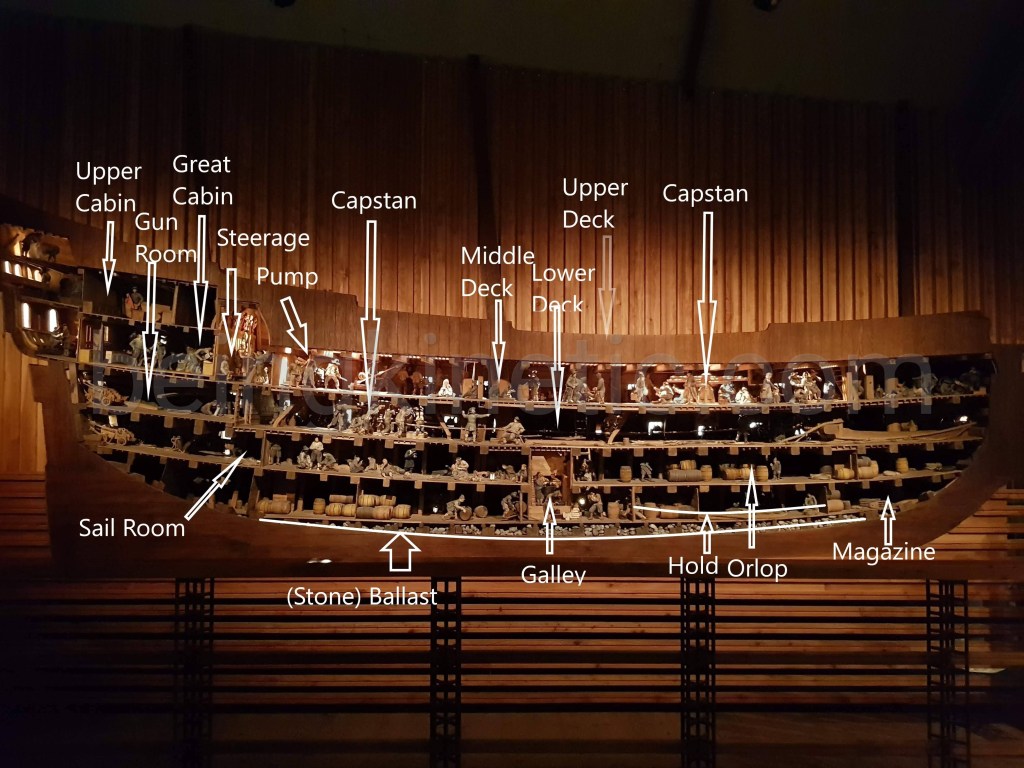
A side-section of the ship should give a fair idea of its internal structure:
Organization
Actors
Crew(145)
- 1 Vice Admiral: Commanded the squadron.
- 1-2 Captain(s): Commanded the ship.
- 2 Lieutenants: Commanded each watch.
- 1 Master: In-charge of rigging, and sailing the ship in one watch.
- 1 Master mate: In-charge of sailing the ship on the other watch.
- 1 Boatswain: Assisted the Master, in-charge of anchor, and damage control.
- 1 Boatswain’s mate: Assisted the Master’s mate.
- 2 Leading Seamen: Leaders on each watch.
- 4 Leading Seamen’s mate: Skilled, and experienced seamen.
- 2 Pilots: Navigation
- 4 Quarter Masters: In-charge of a quarter watch.
- 1 Master Gunner: In-charge of the ship’s cannons.
- 20 Gunners: Each led one, or two gun crews.
- 4 Carpenters: Responsible for maintaining ship’s hull.
- 1 Steward: Managed ship’s provisions.
- 1 Cook: Cooked for the crew.
- 1 Provost: Maintained order.
- 1 Trumpeter/Drummer: Signaling orders.
- 90 Ordinary seamen: Sailing crew.
- 1 Barber: Cut hair, and tended to the sick, and injured.
- 4 Ship boys: Servants to the officers.
- 1 Chaplain: Divine service, and counseling.
Soldiers(300):
2 companies of marines, each contained 150 ordinary men + officers.
Summary
Vasa was a mammoth ship, and an ambitious project undertaken by Gustav II Adolphus to gain a strategic, and psychological edge over Sweden’s rivals.
 Life is about being kinetic