

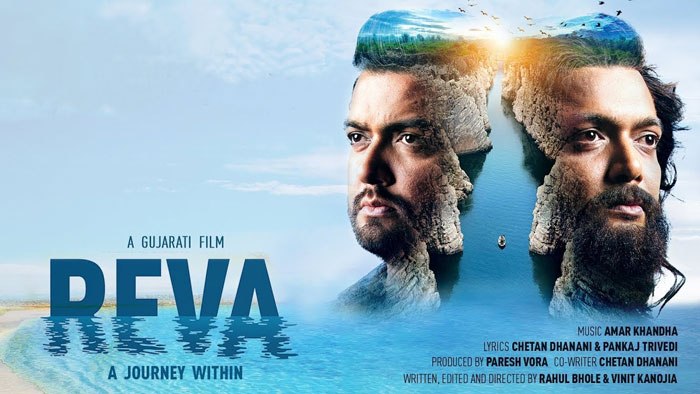
My first visit to the banks of river Narmada was in January 2014(later, in 2016). I spent an enchanting evening besides the river, it’s still a cherished memory. I had only a brief idea about the ‘Narmada Parikrama‘(circumambulation of Narmada) then and hadn’t taken any serious interest in it. Last year, while fondly recollecting the memories of the year 2014 trip, I read more about Narmada Parikrama and in the process, I discovered this movie – Reva. It’s one of the movies that have made an abiding impression on my mind, thereby, it deserves a dedicated blog post. It was this movie that deepened my interest in Narmada Parikrama. I immediately bought and read the book ‘Tattvamasi‘(on which the movie is based), ‘Narmade Har‘ and watched a video-series of one of the parikramawasis.
Instead of writing a long, monolithic/bloated essay(which happens to be my liking 😛 ), I have classified my thoughts in the following sections. Some thoughts might overlap(as per usual!). I have deliberately placed the sections like ‘Quotes’, ‘Scenes’, etc. before expressing my thoughts so that the readers can relate better. Feel free to skip the sections and read the ones that interest you.
Quotes, Dialogues, etc.
Since my knowledge of Gujarati is as good as an infant’s vocabulary, I have provided a humble translation of the original Gujarati quotes in the movie:
The river(Narmada) doesn’t shackle/bind anyone, she just flows freely and similarly, she emancipates everyone. Freedom/emancipation is our birthright.
It’s OK not to have faith in religion but a man should have faith (in something).
The conversations between Shastri and Karan form the core of the movie.
Screenplay
- The strongest point of the movie! I have read the English translation (this has definitely diluted the experience!) of ‘Tattvamasi‘ by Dhruv Bhatt. The screenplay significantly diverts from the book but it doesn’t disappoint, in fact, it’s a commendable adaptation. Somehow, reminds me of Kung Fu Panda(faith and the way events unfold).
- Indian culture and it’s spiritualistic ideals are in unison with the Nature and environment. In fact, the Parikrama itself is an epitome of this statement. The screenplay has done well to prove this.
- It highlights the irony/hypocrisy of the Indian mindset where the beliefs and behavior contradict each other, especially, with the spiritual core of the Indian culture.
- Depicts well Indian village life – unity, happiness and solace in simple events, the hardships and challenges(lack of medical facilities, limited and uncertain sources of livelihood), stoical nature of the villagers and so on.
- Parikrama, from what I have interpreted so far, is an experience that transforms an individual into a better human. The script has done well to exemplify it:
- The most impressive part is the transformation of a materialistic, selfish, arrogant and aimless man into a kind, tolerant, selfless and a humble individual.
- One of the parikramawasi behaves rudely when he is upset with the accommodation but later(when he sees Tempuriya cleaning his room and the village folk working hard for comforting the parikramawasis) not only regrets but also apologizes for his misbehaving.
Scenes
Prime Video has a print of pretty good quality, if you have an Amazon Prime subscription in India, it’s available for free on Prime Video.
Note that I am sharing the scenes available as public videos on YouTube. In case the videos are taken down from the site, please report the same in comments. Since the YouTube embed block of the site doesn’t support starting a video at a particular position, I have just mentioned the starting positions of particularly interesting/important scenes.
- 36:15 Karan mocks an educated man for undertaking parikrama.
- 39:50 An impoverished village man invites Gandu Fakir and other for lunch.
- 42:16 Gandu fakir refuses to eat at the Ashram.
- 52:15 Karan insults the man who requests donation for the parikramawasis.
- 01:02:49 Shastri provides medicinal water to a villager and later explains his ideas.
- 01:07:17 It’s OK not to have faith in religion but a man should have faith.
- 01:09:16 Freedom/emancipation is our birthright.
- 01:10:55 Sombre conversation between Karan and Shastri.
- 01:26:15 Karan loses his patience after Puria’s immolation incident and criticizes the mentality and hypocrisy of the society.
- When asked if he is a parikramawasi at(02:09:25), Karan is unsure but later(02:12:16), he is affirmative.
- 02:13:00 Karan meets the man whom he mocked earlier
- 02:14:38 IMHO, the best scene of the movie – Karan looks the journey ahead as his rebirth, a new life
Characters & Actors
The movie’s climax(when Karan dives in the river) scene pretty much summarizes the characters. Like any well-thought and aptly directed movie, each character feels in-place. Leaving aside the central characters(Karan, Supriya, Bittu-Banga, Gandu Fakir, Gupta and Shastri), the rest also leave a mark – the shrewd and supportive Mehta uncle, the innocent and bubbly Puriya, rowdy but kind-hearted Dityo, the chattering Tempuriya, the kind and responsible ‘Kaalewali Ma‘, the optimistic and assuring ‘Mahant‘, the nameless characters like the educated man who is mocked by Karan, the hospitable tea-stall owner and so on. The make-up of most of the actors is in accordance with the screenplay.
Cinematography
The cinematographers have done an excellent job to cater to each and every aspect of the screenplay. The ashram surroundings, the rugged terrain and hardships of people living in it, the drone shots of Narmada’s basin and flows are various places, several ghats, the abode of ‘Kaalewali Ma’, etc. help the user to relate well to the themes of the movie.
Music and Background Score
A person told me(sadly, I couldn’t get any public links) that Indian Ocean declined the reuse/usage of their song ‘Ma Rewa‘ for the movie which prompted the makers to go for something original. Amar Khandha has given us several sublime creations through this movie, also several lesser-known(in parts of India outside Gujarat and Maharashtra) singers have sung songs soulfully. ‘Ma Rewa‘(slow version), ‘Kaalo Bhamariyo‘, ‘Namami Narmade‘ are so soulful and apt at lyrics that I frequently listen to them. The background score is equally touching – discussion between Shashtri and Karan , Puria’s immolation scene, Kaalewali ma meets Karan
Lyrics
The lyrics are penned beautifully. ‘Ma Rewa’ and ‘Namami Narmade’ are short songs but so aptly describe Narmada, the themes in the movie and the entire Parikrama experience.
Shortcomings
- While Chetan Dhanani has proved his talent in other aspects of the film, as the lead actor he falls short – his Gujarati accent while speaking English(especially, as a person who is brought up in the States), overreaction in aplenty scenes and lack of expressing a range of emotions.
- Monal Gajjar’s makeup is not only flashy but also illogical, given her daily routine and a hardworking life in a remote village. It feels so of-the-place that viewer finds difficult to fit her in the character of Supriya.
Lessons, Philosophy
- We cannot control the events that occur in our life, it’s only with time the mysteries (might!) unfold.
- Many incidents, especially the unpleasant ones, often are merely triggers or channels for much larger transformations in life. It’s only in the retrospective, that we realize this fact.
- People and societies living closer to and in harmony with the Nature are benevolent and magnanimous.
- Be kind and humble – we never know how our behavior might affect the others, at least, we should be concerned about the consequences of our deeds – Karma.
Closing Notes
- I encourage the users to read more about the Narmada Parikrama.
- I doubt that I have expressed all my emotions and observations about the movie. I may update this post in the future.
- I would love to have a constructive discussion about this movie in the comments section. I am willing to include the comments (along with the full credits) that appeal to me in the main body of the post.
 Life is about being kinetic
Nice summary and apt observation on screenplay and shortcomings .Indeed a very good movie
LikeLiked by 1 person