Background
Limestone was formed 135-70 million years ago during the Cretaceous period . In some of the coastal Skåne, the limestone layer is up to 40 meters thick. Interspersed with the limestone is flint . It was also exploited and used as a building material. Not just in Skåne but also in Gotland and other lime-rich areas, houses plastered with lime are visible and used, even today.

Some areas feature a rare geological anomaly where the Scanian limestone bedrock (kalkgrunden) rises directly to the surface, making it an industrial hotspot for lime production.
Context
The limestone mining and lime extraction in Skåne dates from the early 18th century to 1954(when it was finally shut down due to economic infeasibility). One of the time-consuming, energy intensive process was extraction of lime from limestone. Large lime kilns, ‘field kilns'(Swedish: fältkalkugnar) like the one shown below were used for this purpose. It is known as Wendt’s Kalkugn, built in the mid-19th century by a German entrepreneur named Herman Wendt. I am sure most of us find the following formula familiar 😛 :



Kilning Process
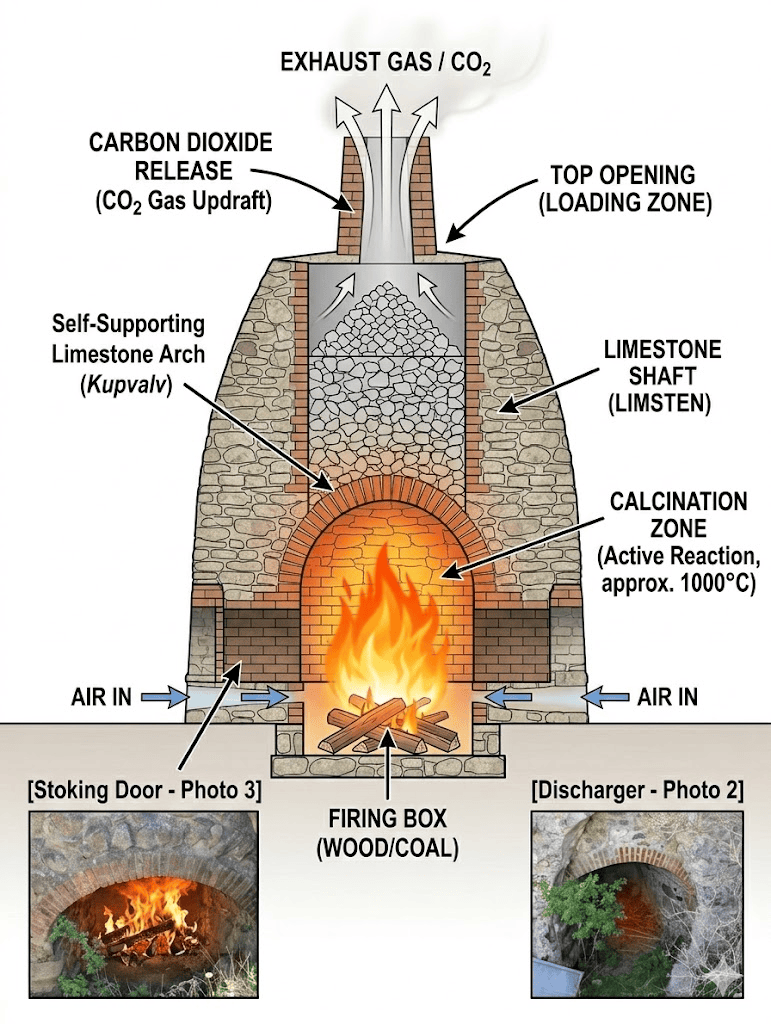
The thick, conical exterior walls are constructed from local fieldstones, flint, and brick. This massive masonry design serves a crucial engineering purpose: thermal mass. To transform limestone into quicklime, the interior temperature must be brought to and maintained at approximately 1000 °C to 1050 °C . The tapered beehive shape helps deflect coastal winds while trapping immense heat inside the central shaft.
The operation of a field kiln like this was a highly skilled, intermittent process that ran in distinct batches, taking about 40 hours per burn cycle. Each cycle consisted of 30-35 ton of limestone. Earlier, wood was used, later, coal. 5-6 ton of coal was needed for a single batch, making it one of the most energy-intensive manufacturing.
| Component | Material Type | Mass (kg) | Operational Role |
| Input (Top) | Raw Limestone (Limsten) | ~35,000 kg | Loaded over the engineered Kupvalv |
| Fuel (Base) | Industrial Coal (Stenkol) | ~3,800 kg | Burned continuously over 40 hours |
| Waste (Exhaust) | Carbon Dioxide Gas CO2 | ~15,400 kg | Lost to the atmosphere via updraft |
| Output (Bottom) | Finished Quicklime CaO | ~19,600 kg | Cooled for 2 days, then raked out |
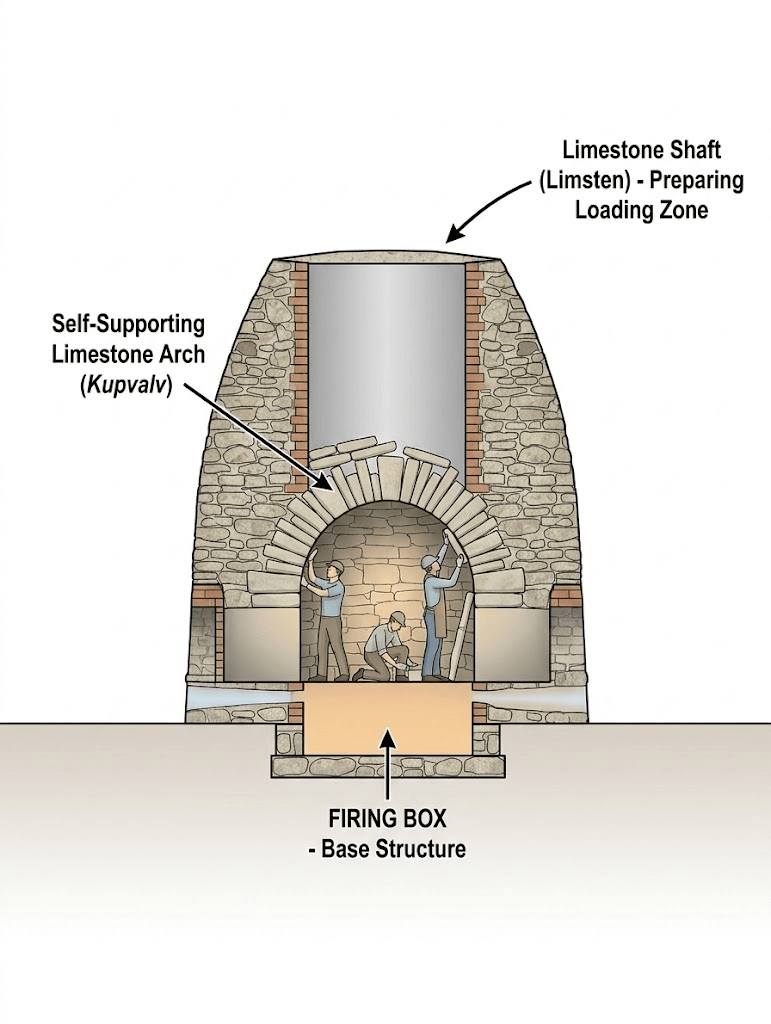
Step 1: The ‘Kupvalv’ Engineering (Loading)
he operation began with highly skilled manual labor inside the empty, cold kiln. Before any rock could be loaded, workers constructed a temporary, self-supporting arch (kupvalv) directly above the FIRING BOX. This structure is critical because it creates the void for the fuel and holds the weight of the entire LIMESTONE SHAFT load, ensuring that hot gases can rise evenly through the rock pile.
Step 2: Firing and Calcination (Operation)
Once the structure was engineered, the shaft was filled with raw Limsten (limestone fragments). Fuel (originally wood, later coal) was loaded into the FIRING BOX. The fire was lit and continuously stoked, often for 40 consecutive hours. This required precise regulation of the airflow through the specialized base ports
Step-3: Collapsing the kupvalv
If the Kupvalv survived the firing, you could indeed rake out the quicklime from the Limestone Shaft above it. However, you would not be able to empty the massive load of the entire, full shaft. The arch would create a bridge, trapping 90% of the material inside the 18-meter-high cone.
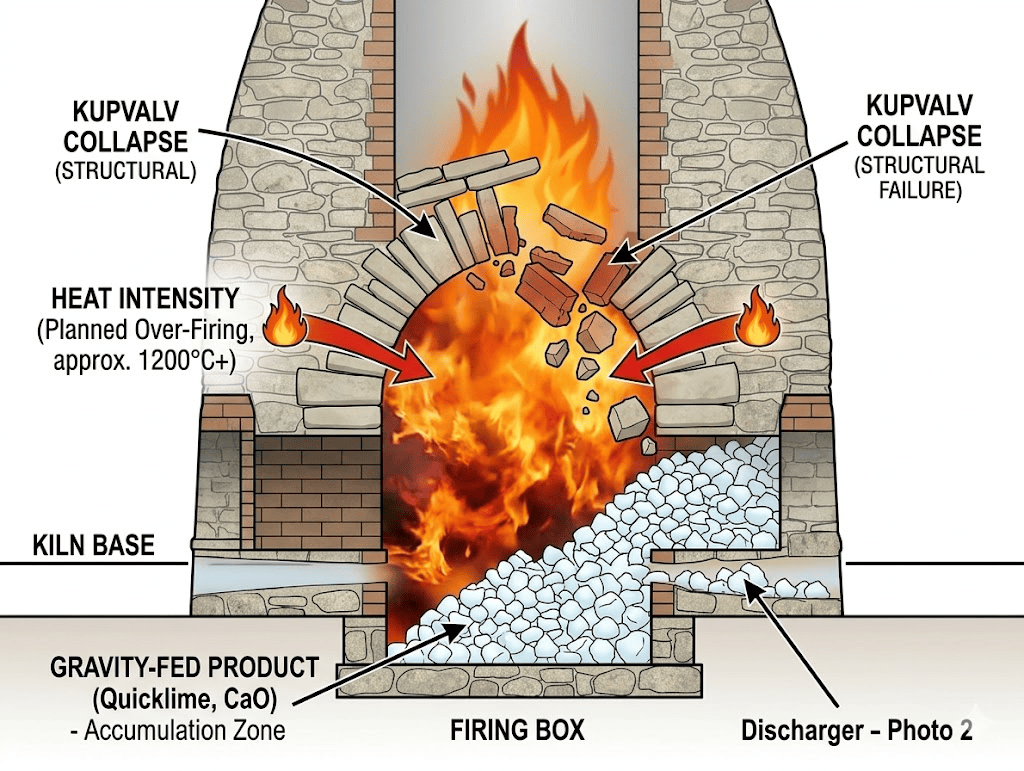
The final step of the firing phase was not defined by temperature, but by a planned engineering event: the collapse of the primary Kupvalv.
- Calcination: The entire kiln is brought to 1000 °C and the limestone changes chemically into quicklime. The arch is still standing.
- Controlled Failure: Near the very end of the 40-hour burn, the stoker would deliberately alter the firing. Instead of a balanced stoke, they would push the temperature in the FIRING BOX to its absolute structural limit—likely approaching 1200 °C or higher.
- The Collapse: Under this final, extreme blast of localized heat, the mortar and the bricks of the Kupvalv arch would catastrophically fail, losing all structural rigidity. The arch would buckle and collapse into the FIRING BOX below.
The result: With the arch gone, the entire contents of the Limestone Shaft, now a pure stack of unstable Quicklime, would gravity-feed straight down into the collection zone.
Step 4: Retrieval of the Final Product (Quicklime)
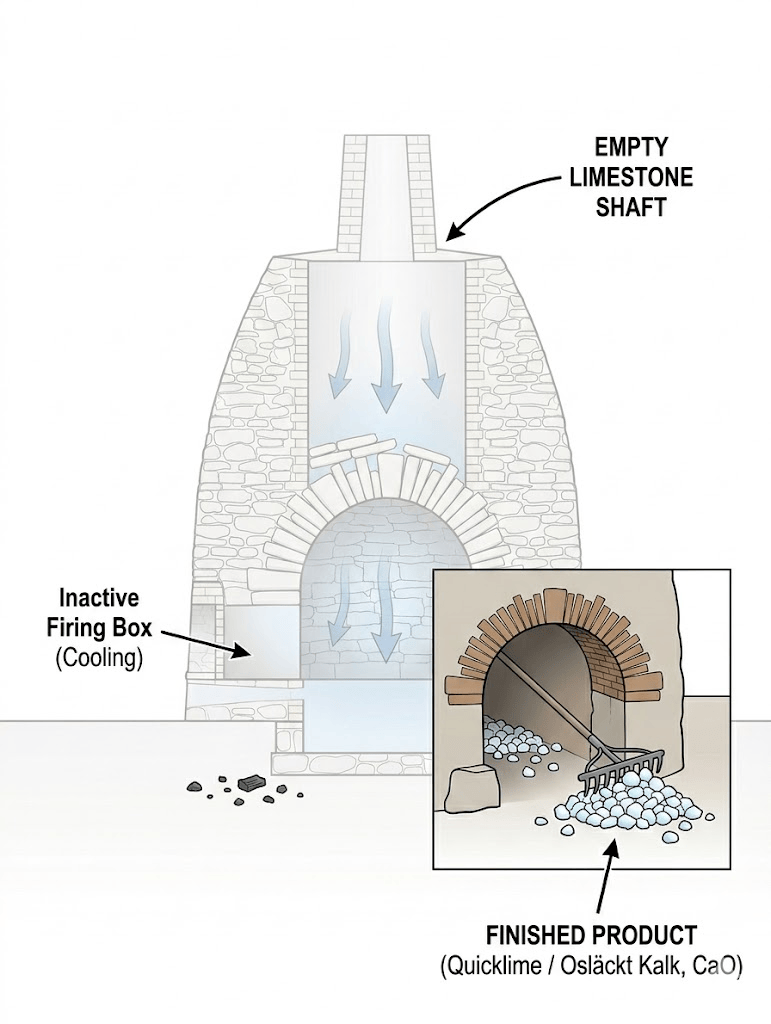
After the 40-hour burn was complete, the stoking ceased. The massive stone structure held its heat, so the kiln had to be left undisturbed to cool down for up to two days. Once it was safe to operate, workers began the volatile process of extracting the finished product from the base.
The 20 tons of extracted quicklime was incredibly light compared to the heavy raw stone put in, meaning a single horse-drawn wagon or narrow-gauge rail car could transport far more finished building product.